Research That Aims Higher for People Facing Recurrence
A Potential New Kind of Oral Treatment for Platinum‑Resistant Ovarian Cancer
Clinical Trial Now Enrolling
After completing chemotherapy, hearing that your ovarian cancer has returned can be a lot to take in. This is a moment to pause, ask questions, and think about what comes next. While this may not be the outcome you hoped for, you still have choices about what comes next. One option may be learning more about clinical research and seeing if participating in a study is right for you.
About the Phase 3 ASPENOVA
Clinical Trial
The Phase 3 ASPENOVA clinical trial is evaluating a new investigational therapy to treat platinum-resistant ovarian cancer (which may also be referred to as PROC).
For people living with this form of ovarian cancer, treatment options are often limited, and new approaches are urgently needed. This trial is designed for people whose ovarian cancer recurred within six months of platinum-based chemotherapy. It uses biomarker testing (a special type of noninvasive testing) to help identify the people most likely to benefit. About 50% of people with PROC may be eligible.
ASPENOVA is built on earlier research into a potential non-chemotherapy treatment. Researchers are comparing this new investigational therapy with the standard-of-care chemotherapy to learn more about this approach.
Because this treatment is still being studied, it is not yet approved and is only available through clinical trials. What researchers learn from this study may help with the development of new treatment options for platinum-resistant ovarian cancer. If ASPENOVA is successful, this therapy could receive regulatory approval and become commercially available, potentially benefiting more people in the future.
How the
Clinical Trial
Works
Participants in the study will be assigned to receive either:
Randomization helps researchers fairly compare approaches. All participants receive active treatment and close medical monitoring.
The study is conducted at top institutions across the country, giving access to clinical teams and an opportunity to contribute to scientific advancement.
No additional biopsy is required. With your consent, the trial team can use tissue samples previously collected by your physician to test for the biomarker expression.
Participants who join this study are choosing to:
Information for Physicians
Criteria for the Phase 3 ASPENOVA Clinical Trial
The ASPENOVA clinical trial is evaluating an investigational first-of-its-kind, small-molecule, highly selective oral WEE1 kinase inhibitor.
Eligibility is determined by Cyclin E1 protein expression, as assessed by the clinical trial diagnostic test, which helps identify patients who are most likely to experience benefits from the treatment.
This expands the eligibility beyond patients with CCNE1 gene amplifications, opening the door to a broader group who may benefit from this investigational therapy.
About the Investigational Treatment
Evaluating a WEE1 Inhibitor, a New Type of Therapy










Cell division is a normal process:
Cells in our bodies divide every day as a part of normal growth and repair.
Before a healthy cell divides, it slows down to check for DNA damage.
A protein called WEE1 acts like a brake, giving the cell time to repair any problems before moving forward.
This helps cells stay healthy and function as they should.

Cancer cells behave differently:
Cancer cells often rush through early checkpoints without fixing problems, which causes damage to build up.
But cancer cells can’t survive if there’s too much DNA damage.
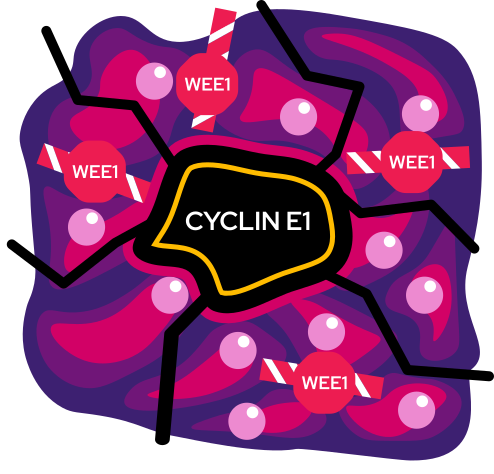
To survive, ovarian cancer cells rely on WEE1 at a later checkpoint. WEE1 slows them down, helping keep the damage at a level the cells can tolerate.
Some ovarian cancer cells have high levels of a protein called Cyclin E1, which drives them to divide even faster and increases damage. This added stress makes the cells more reliant on WEE1 for survival.
This is what Azenosertib does to a cancer cell:
Azenosertib is designed to block WEE1. When WEE1 is blocked, the cancer cells don’t slow down to repair themselves, and they keep dividing.
Eventually, the damage becomes overwhelming and the cancer cells can’t survive.
Eligibility
Do You Qualify for the Trial?
You may be eligible if you:
To see if you are eligible, talk to your doctor about testing your cells for Cyclin E1 expression.
Cyclin E1 testing can be done using your tissue sample from a previous biopsy or surgery. For most patients with platinum-resistant ovarian cancer, there is usually an existing tissue sample that can be used.
Cyclin E1 testing is not a standard part of care. It is done specifically to determine eligibility for this trial. If there is not enough tissue available for testing, your care team can discuss with you what next steps are appropriate.
Site Locator
Find a Trial Site Near You
Use the site locator to quickly identify participating ASPENOVA clinical trial locations in your area.